The Death of Baldr: The Shattered Light of Asgard
Among the many epic tales of the Norse gods none pierces the heart quite like the death of Baldr, the shining god of light. His fall marks not only a tragedy of love and loss, but the moment the threads of destiny began to tighten, leading all creation toward Ragnarök, the twilight of the gods.
This is the story of how light itself was extinguished; and how, even in the darkness, a faint hope endured.

The Beloved God of Light
Baldr, the son of Odin, the Allfather, and Frigg, the gentle queen of Asgard, was the most radiant of all the gods. His presence brought warmth and harmony to all the Nine Realms. The flowers seemed to bloom brighter where he walked, and even the harshest hearts softened in his light.
But peace cannot last forever, even among the gods.
One night, Baldr began to dream, not pleasant dreams of triumphs or of spring’s renewal, but a nightmare of shadow and death. He dreamed of falling into darkness, of the world weeping, and of a silence that swallowed all sound. Each morning he awoke trembling, his fair face pale, unable to shake the dread that clung to him like frost.
These dreams spread unease throughout Asgard. The gods gathered in Valaskjalf, Odin’s silver-roofed hall, their brows furrowed with worry. Dreams in the realm of gods were not mere phantoms of the mind: they were warnings.
Odin, wise beyond all others, knew this truth well. If death stalked his son, then fate itself was moving.

Odin’s Journey to the Underworld
To learn the meaning of the dreams, Odin took up his spear Gungnir and mounted his eight-legged steed Sleipnir. Cloaked in gray, he rode far beyond the lands of the living, across the dark rivers that divided the worlds, down to Hel, the shadowed realm of the dead.
There he sought the mound of an ancient völva, a prophetess long buried, whose spirit could still speak the secrets of fate.
When Odin arrived, he found the underworld strangely alive. The halls of Hel were being made ready for a great feast. Tables were laid with shining cups, mead poured, benches polished. The air buzzed with quiet anticipation, as though all the dead were preparing to greet a noble guest.
A chill gripped Odin’s heart. He stood over the völva’s grave and spoke the words of awakening. The earth trembled, and from the shadows came her voice, dry as winter wind, yet filled with power.
“Who disturbs my rest? Who calls me from the halls of Hel?”
“I am,” Odin answered, though he gave no name. “Why are Hel’s halls adorned for revelry? Who is the guest they await.”
The seeress was silent for a long time, then said,
“The feast is laid for Baldr. The underworld readies itself for his coming.”
Odin’s grip tightened on his spear. “Tell me,” he demanded, “who shall bring this doom upon him?”
The völva’s tone darkened.
“You ask too much, Allfather. I see your own end as well.
Ride home, and meet your sorrow.”
And then, her voice faded, and the grave was silent once more.
Odin rode back to Asgard heavy with grief. The truth he had sought was now a burden he could not cast off.
Frigg’s Oath of Protection
When Frigg heard of the prophecy, despair filled her heart. Her beloved son, so gentle, fair, and innocent, could not be lost to the shadows. She swore to defy fate itself.
From that day forward, Frigg traveled across the Nine Realms, pleading with every being and every element to promise never to harm Baldr. Fire and water swore the oath. Iron and stone, beasts and trees, poisons and diseases - all promised to spare him.
Her love was tireless, and her will unbending. None refused her.
All but one.
In her travels, she passed by a small, slender plant, the mistletoe, growing upon an oak branch in the west of Valhalla. It was so young, so fragile, that she thought it incapable of harm. “Surely,” she said softly, “this tender sprig could never wound anyone.”
And so, she did not ask it for an oath.
In that moment of mercy, or perhaps of oversight, fate found its thread.
The Gods’ Game of Invincibility
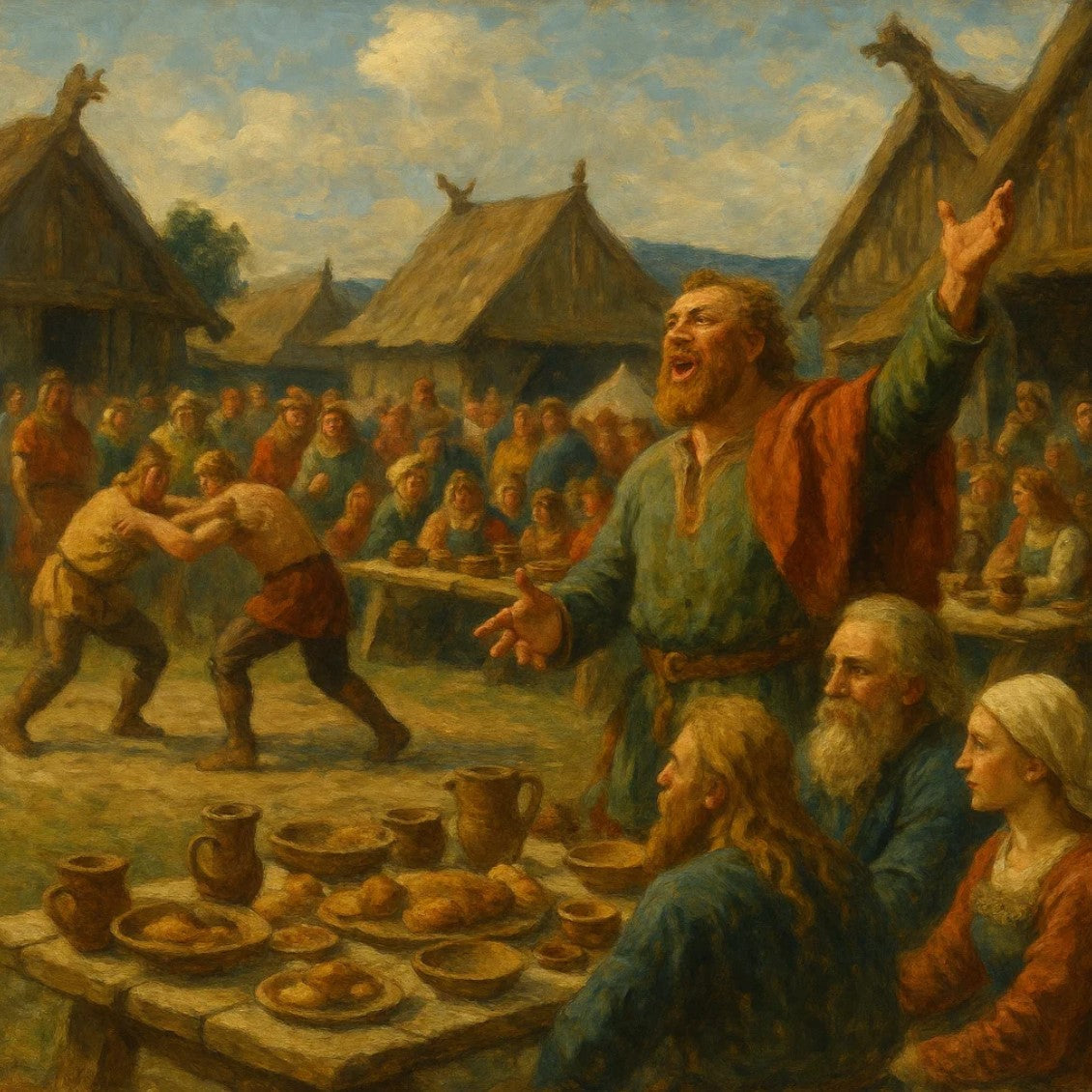
When Frigg returned to Asgard, she told the gods that her son could no longer be harmed. To prove it, they gathered in the bright fields of Idavoll. One by one, they hurled weapons and stones at Baldr.
Spears shattered against his chest. Swords bounced from his skin. Even Thor, mighty with Mjölnir, struck him with the flat of his hammer, and Baldr only laughed.
The gods roared with joy. The air was filled with laughter and the music of celebration. They had turned fear into festivity. Baldr, the shining god, had become their living symbol of safety and peace.
But not all hearts shared in their mirth.
Odin, standing apart, watched in silence. Though his face was calm, the memory of the völva’s prophecy burned in his mind. He saw his son smile, both radiant and untouched, but yet his heart felt the weight of inevitability.
And somewhere, hidden among the crowd, Loki watched too. The trickster’s eyes glinted with envy. To him, Baldr’s perfection was a wound. Where Baldr brought joy, Loki brought unease; where Baldr was loved, Loki was distrusted. And so, his jealousy festered, twisting into a plan that would give the prophecy form.

The Trickster’s Deception
Loki’s cunning knew no rest. He disguised himself as an old woman, all frail, wrinkled, and cloaked, to journey to Fensalir, the hall of Frigg.
There, he found the goddess spinning threads of silver, her heart at peace now that her son was safe.
“Tell me, Lady Frigg,” the old woman croaked, “is it true that your son cannot be harmed by any weapon or creature?”
Frigg smiled. “It is true. Every thing in all the worlds has sworn an oath never to harm him.”
Loki’s voice wavered, feigning innocence. “Every thing, you say? Surely there must be something so small, so gentle, that it need not take such an oath.”
Frigg laughed softly. “Only one - a young mistletoe plant growing west of Valhalla. It seemed too frail to swear such a promise. What harm could mistletoe ever bring?”
That was all Loki needed. He bowed and thanked her kindly, then slipped away, the mask of age melting from his face as he vanished into the forests.
There he found the mistletoe: pale green, innocent, and cold to the touch. With cruel precision, Loki shaped it into a slender dart, smooth and sharp as fate’s own blade.
He held it up to the sun, and in its glint, he saw the ruin of Asgard.
The Death of Baldr
The gods gathered once more in the field to play their harmless game. Their laughter filled the skies; the air shimmered with joy.
But on this day, Loki approached Höðr, Baldr’s blind brother, who stood apart from the crowd. Höðr listened to the sounds of laughter with sadness.
“Why do you not join them, Höðr?” Loki asked.
“Because I cannot see where my brother stands,” Höðr said quietly. “I would bring no honor to him.”
“Let me guide your hand,” said Loki, his tone soft and coaxing. “You should honor him as the others do. I will place the dart for you. Fear not, for no weapon forged by might could harm him. This frail dart carries no doom in its flight."
Höðr hesitated, but Loki placed the mistletoe dart in his hand. He guided his aim, whispering, “Now.”
The dart flew.
It struck Baldr in the chest.
For a heartbeat, all was still. Then Baldr gasped, staggered, and fell already lifeless upon the green earth.
Silence fell over Asgard. The laughter died in the throats of the gods. Frigg screamed, her grief echoing across the heavens. Odin’s face darkened, for he knew the prophecy had come to pass.
No one moved. No one breathed. The god of light was gone.
The Funeral of the Shining One
The gods lifted Baldr’s body and carried him to the shore, where his great ship, Hringhorni, awaited. It was the largest vessel ever built — vast enough to carry a god to his final rest. They adorned him with flowers and treasures, placing beside him his beloved wife Nanna, whose heart broke at the sight of his still face.
But when they tried to push the ship into the water, it would not move. Even Thor’s mighty strength could not budge it.
So they sent for Hyrrokin, a giantess from Jotunheim, whose power was said to shake mountains. She arrived riding a wolf, serpents for reins. With a single shove, she sent the ship crashing into the waves. The force was so great that the earth trembled, and Thor, enraged by her strength, raised his hammer; but the other gods restrained him.
The pyre was lit. Odin placed upon Baldr’s chest his golden ring, Draupnir, which dripped eight new rings every ninth night - a symbol of eternity and renewal. Flames roared high, reaching toward the heavens. The sea burned red and gold. The air filled with the sound of weeping.
Even the giants wept that day.
As the fire consumed the ship, the smoke rose like a spirit into the sky. And with it, the joy of Asgard departed.

The Plea to Hel
But Frigg’s grief could not rest. She begged the gods to find a way to bring Baldr back from the realm of the dead.
Hermóðr, brave son of Odin, volunteered. He mounted Sleipnir and rode for nine nights through dark valleys and shadowed mountains, until at last he reached the gates of Hel.
He found Baldr seated there, pale and noble, though sorrow dimmed his light. Hermóðr begged Hel, the queen of the dead, to release him.
Hel listened and replied,
“If all things in the world will weep for Baldr, then I shall let him return to Asgard. But if even one refuses, he must remain with me.”
Hermóðr rode back with her message, and the gods sent word across all realms. Every creature wept: both men and beasts, trees and stones, even the earth itself shed tears for Baldr.
But one being, a giantess named Thökk, refused.
She sat upon her rock and said coldly,
“Let Hel keep what she has. Why should I weep for Baldr? He never brought me joy.”
Many believed that Thökk was Loki in disguise. And so, because of her refusal, Baldr remained in the underworld.
The Beginning of Ragnarök
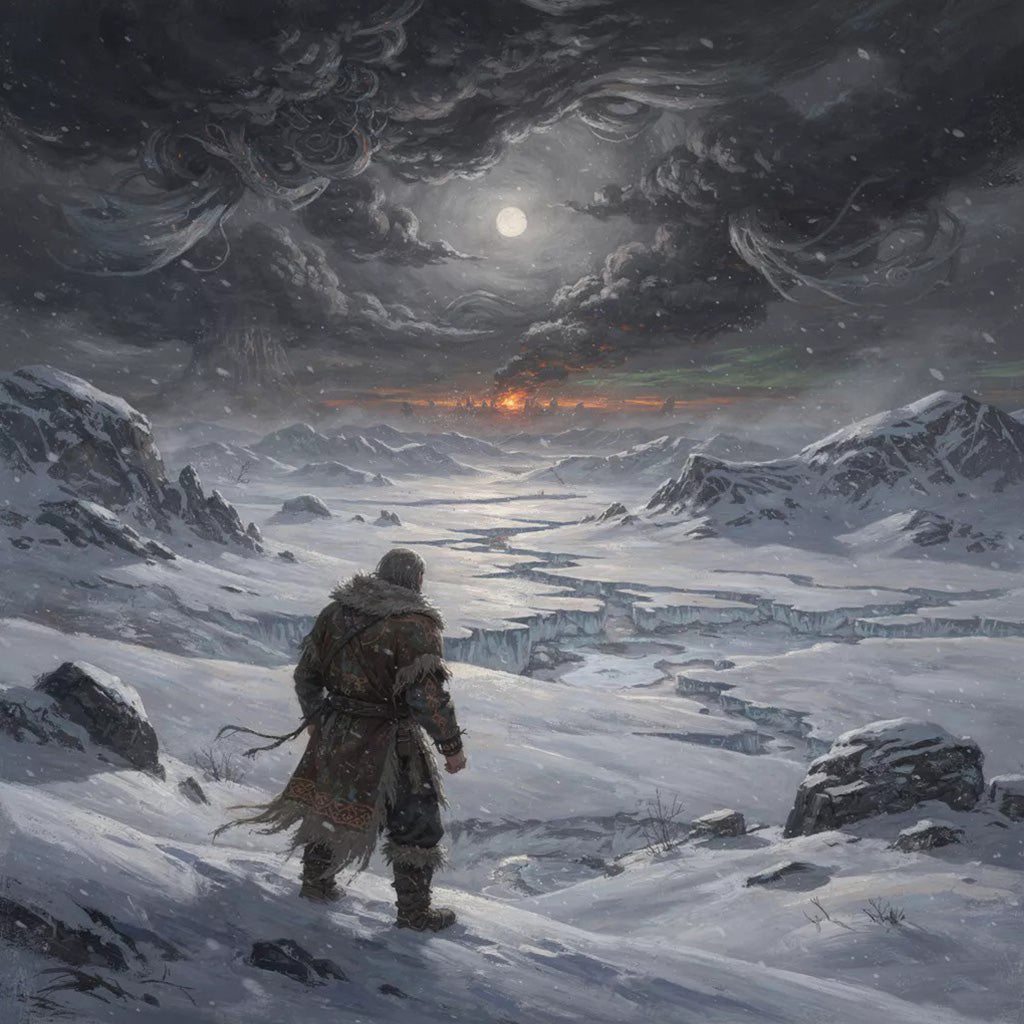
Baldr’s death broke the balance of the worlds. The light of Asgard was dimmed, and the gods turned their wrath upon Loki. They hunted him, bound him with the entrails of his own son, and chained him beneath the earth. Venom dripped upon his face from a serpent above, and his screams of agony shook the mountains.
Yet even in punishment, Loki’s hatred burned. His suffering became the spark of vengeance that would one day ignite Ragnarök: the final battle, when gods and giants would fall, and the world itself would be consumed in fire.
The death of Baldr was the first stone cast into that dark river of destiny. It marked the end of innocence, the beginning of doom.
But even so, the story does not end in despair. For prophecy tells that after the fire and ruin of Ragnarök, a new world will rise from the sea - green, pure, and bright once more. And in that new dawn, Baldr shall return, shining with a light untouched by sorrow.
The tale of Baldr is one of beauty and heartbreak: a story of a love so great it defied even death, and of a fate so powerful it could not be denied.
His death reminds us that even gods cannot escape destiny, that even light casts a shadow. Yet it also carries a promise: that after darkness comes renewal, after grief comes rebirth.
And so, when the long night ends and the world is remade, Baldr’s light will shine again: gentle, eternal, and unbroken.